A company is raising investment.
The founder opens a dashboard.
Downloads are growing. Customer acquisition looks efficient. Revenue is increasing. Meta shows thousands of conversions. Google reports an excellent return on ad spend. The app has hundreds of thousands of installs.
The presentation looks convincing.
But there is one question investors should ask before trusting any of those numbers:
Who owns the truth behind them?
Because the answer should not simply be Meta, Google, TikTok, Firebase, Adjust, AppsFlyer, or any other third-party platform. And it definitely should not be a screenshot in a pitch deck.
Marketing and analytics platforms are powerful measurement tools. But they are not necessarily a company's permanent source of truth.
For investors, understanding the difference can mean the difference between investing in verified growth and investing in a story built around numbers that cannot be independently reproduced.
The Biggest Mistake in Digital Due Diligence
Financial due diligence is standard practice. Investors review revenue, expenses, liabilities, contracts, and financial records. But when it comes to digital growth, many investors are shown dashboards instead.
That is not the same as verifying data.
A marketing platform is designed to measure and optimize marketing activity. An analytics platform is designed to analyze user behavior. An attribution platform is designed to assign credit to marketing touchpoints.
None of them should automatically be treated as the company's ultimate source of truth.
This matters because digital metrics increasingly influence how companies are valued. Investors look at customer growth, app installs, customer acquisition cost, conversion rates, retention, lifetime value, and revenue attributed to marketing.
If those numbers are inaccurate, selectively presented, duplicated across platforms, or impossible to reproduce, the investment decision may be based on an incomplete picture of the business.
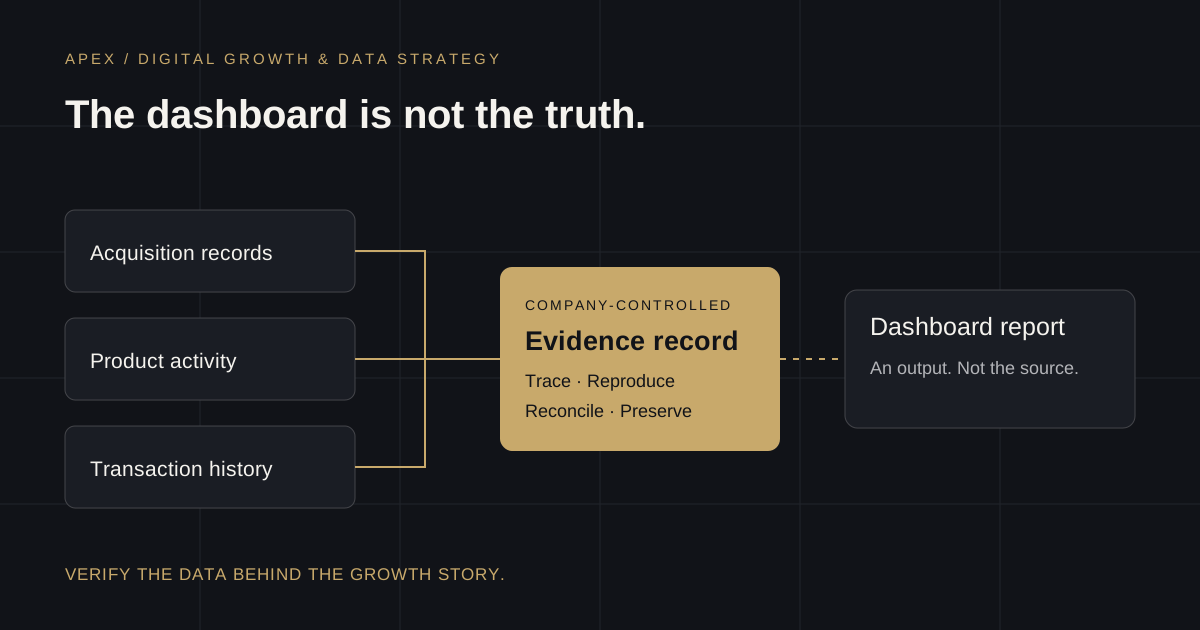
A dashboard is a report. It is not automatically evidence.
The Dashboard Problem: Multiple Platforms Can Claim the Same Customer
Every advertising platform has its own measurement system. Meta measures Meta. Google measures Google. TikTok measures TikTok.
Each platform has its own attribution rules, conversion definitions, and reporting logic. This creates a fundamental problem: the same customer can potentially be claimed by multiple platforms.
Imagine this journey:
- Ad impression
- Click
- App install
- Registration
- Purchase
- Retention
A customer may interact with multiple marketing channels before becoming a customer.
If every platform claims credit according to its own attribution rules, simply adding reported conversions together can create a misleading picture.
This is why platform-reported conversions should be reconciled against the company's own customer and transaction records. Our Digital Growth & Data Due Diligence service investigates those connections rather than accepting a dashboard total at face value.
Conversion Windows Don't Tell the Full Customer Story
Third-party platforms measure activity according to their own attribution rules and reporting windows. A dashboard can tell you what happened within its measurement framework. That does not necessarily mean it contains the complete history of what happened to that customer.
Consider a subscription app. A company spends money to acquire a user in January. The user installs the app, creates an account, becomes inactive, returns months later, starts a subscription, and remains a paying customer for two years.
The company needs to understand the complete journey:
- Where did the user originally come from?
- How much did it cost to acquire them?
- When did they become a paying customer?
- How long did they remain active?
- How much revenue did they generate over their lifetime?
If this information is not independently stored by the company, reconstructing the real customer journey later can become extremely difficult.
Apps Create an Even Bigger Due Diligence Challenge
For many website businesses, the customer journey can be relatively simple: visit → lead → sale.
For apps, it can be much more complex:
- Marketing spend
- Ad impression
- Click
- App Store
- Install
- First open
- Registration
- Activation
- Purchase
- Subscription
- Renewal
- Retention
Each stage may exist in a different system. The advertising platform may record the click. The App Store may report the install. An attribution platform may assign the source. An analytics platform may record product activity. The company's backend may store the customer account. The payment system may record the transaction.
So which platform contains the complete truth?
No single marketing dashboard does.
The real source of truth should be a company-controlled data environment that connects and preserves critical business data over time.
The Metrics That Can Look Better Than Reality
Not every discrepancy means intentional manipulation. Sometimes the problem is poor implementation or weak data architecture. But investors should understand where reported metrics can create a misleading picture.
Installs Are Not Active Users
An app can have one million installs. That does not mean it has one million active users or one million valuable customers.
Ask:
- How many opened the app more than once?
- How many completed registration?
- How many completed the core product action?
- How many made a purchase?
- How many returned after 30 days?
- How many are still active today?
Registrations Are Not Customers
A company may report hundreds of thousands of registered users. But how many are active, verified, unique, paying, or retained?
The definition of every major metric should be clear before the number is evaluated.
Attributed Revenue Is Not the Same as Actual Revenue
Marketing platforms may assign credit to transactions according to their own attribution rules. That is different from confirming actual revenue.
Financial and transaction records should confirm whether revenue exists. Digital attribution data should help explain how customers were acquired and what influenced their journey. Marketing attribution should never replace financial reconciliation.
Retention Depends on the Definition
Retention can be calculated in different ways. A company may measure it based on all registered users, activated users, paying users, or users who completed a specific event. Each approach can produce a different result.
Investors should understand exactly who is included in each cohort and how retention is calculated.
The Practical Digital Due Diligence Framework
01 / Identify the Source of Every Major Metric
For every important number, ask: where does this number originate? Identify the original source and determine whether it can be verified.
02 / Test Whether the Number Can Be Reproduced
An independent analyst should be able to understand:
- The metric definition.
- The original data source.
- The calculation.
- The date range.
- Any exclusions or filters.
If a number cannot be reproduced, it should not automatically be treated as verified.
03 / Reconcile the Complete Customer Journey
- Marketing spend
- Click
- Install
- Registration
- Activation
- Purchase
- Retention
- Lifetime value
Review whether the numbers logically connect at every stage.
04 / Separate Platform Attribution From Business Reality
Do not treat platform-reported conversions or attributed revenue as the company's complete business record. Compare platform data against:
- Internal customer records.
- Backend databases.
- CRM data.
- Transaction and payment records.
- Subscription and renewal records.
05 / Audit the Tracking Infrastructure
Review the systems behind the numbers, including:
- App event implementation.
- SDK configurations.
- Server-side events.
- Conversion tracking.
- Duplicate events.
- User identity logic.
- Backend integrations.
- Attribution settings.
- Historical data storage.
- Dashboard calculations.
A beautiful dashboard built on bad tracking is still bad data.
To discuss the evidence available for your review, request a Digital Due Diligence Review. For broader measurement work, explore our services and our guide to optimizing digital advertising campaigns.
What a Real Source of Truth Should Look Like
A serious digital business should not rely entirely on third-party dashboards to preserve its history. Critical data should be stored in a company-controlled environment.
This should include:
Customer Identity
A unique internal customer ID connecting activity across systems.
Acquisition History
The original known acquisition source and relevant campaign information.
Product Events
The key actions that demonstrate genuine product usage.
Transactions
Purchases, subscriptions, renewals, cancellations, and refunds.
Retention History
Historical activity that allows the company to analyze customer cohorts over time.
Marketing Spend
Historical spend data that can be used to calculate real acquisition costs and profitability.
The goal is simple: the company should still be able to understand what happened years later—even if a third-party platform changes its reporting, attribution, or data access.
Company-controlled does not mean collecting everything forever. Access controls, consent, lawful retention periods and deletion requirements still apply. Identity gaps and unavailable historical records should be documented as limitations, not filled with assumptions.
Questions Every Investor Should Ask
- Who owns the raw data?
- Where is historical data stored?
- Can these metrics be independently reproduced?
- How are unique users identified across platforms?
- Can multiple platforms claim the same conversion?
- What is the difference between attributed revenue and actual revenue?
- How are refunds and cancellations reflected?
- Can retention be verified using the company's own customer records?
- What happens if a third-party platform changes its reporting rules?
Don't Invest in a Dashboard. Verify the Business Behind It.
Digital companies are increasingly valued based on growth data. That means the quality, ownership, history, and integrity of that data should be treated as a business asset.
The dashboard is a report. The advertising platform is a measurement tool. The company's independently verifiable and historically preserved data should be the evidence.
At APEX Performance, we believe growth data should be:
When investment decisions are based on digital growth, the most important question is not what the dashboard says. It's whether the company can prove it.
Learn more about Digital Growth & Data Due Diligence or contact APEX Performance to discuss your review. For another perspective on separating platform outputs from commercial judgment, read Human Targeting vs AI Targeting.
Frequently asked questions
Is digital growth due diligence a financial audit?
No. This is an independent review of digital growth data, measurement, attribution and tracking infrastructure. It does not replace financial, legal or statutory audits, investment advice, or the work of qualified advisers.
Can platform-reported conversions be added together?
Not automatically. Different platforms may claim the same customer under different attribution rules. Definitions, windows and identity logic must be examined and compared with company-controlled customer and transaction records.
What if the historical data cannot be reproduced?
The review should identify the missing evidence, explain what can and cannot be validated, and document the limitation. A dashboard screenshot alone does not resolve an unavailable source record.
Examples in this article are illustrative. Results depend on offer, market, budget, tracking and sales process, and are never guaranteed.
← Back to all articles