Many brands pick advertising platforms for the wrong reasons: a competitor is on TikTok, an agency favors Instagram, or a platform is simply popular. Learning how to choose the right social media platform for your business means replacing popularity with evidence from your own audience and your own tests.
The right platform depends on the target audience, product or service, buying behavior, creative format, campaign objective, conversion economics and actual performance data. No platform is universally superior.
Start with the audience and business objective
Describe your customer before you look at platforms: age range, location, interests, professional role, purchasing intent and where they are in the buying journey. A founder researching accounting software behaves differently from a shopper browsing gifts.
B2B and B2C differ in practice
B2C purchases are often shorter and more visual, driven by impulse, interest or price. B2B purchases usually involve several decision-makers, a longer sales cycle and higher value per customer. A B2B lead costing more per click can still be efficient if each customer is worth far more. Define the objective, such as qualified leads, purchases or bookings, before comparing channels.
Understand the strengths and limitations of each platform
Meta Ads (Facebook and Instagram)
Broad reach and flexible formats, suited to visual consumer brands, local services, e-commerce and lead generation. Results depend heavily on creative and clean conversion data. Facebook Ads vs Instagram Ads is largely a placement question inside the same system.
TikTok Ads
Short-form video discovery. It can suit brands with strong, native-feeling creative and younger or interest-led audiences. It demands a steady supply of video, and intent can be lower.
LinkedIn Ads
Targeting by job role, industry and company, which suits professional B2B services. Costs per click are typically higher, so the value of each customer needs to justify them.
YouTube Ads
Video storytelling for consideration and remarketing. Useful for explaining complex products or building familiarity, and often measured through assisted impact as well as direct conversions.
Google Search Ads as a complementary channel
Google Search Ads are a search channel rather than a social platform. They capture people already searching, so they partner well with social channels that create demand. Google Ads as a whole also covers YouTube and Display, which behave differently. High-intent searches often convert differently from social leads, so judge them separately.
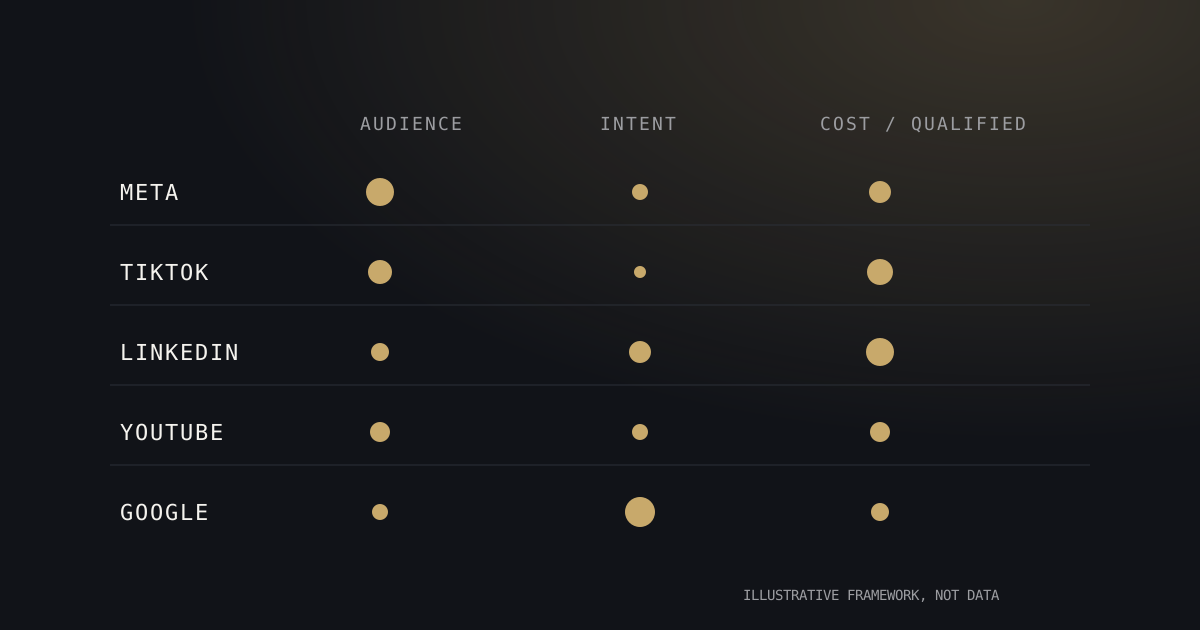
Platform-selection matrix
| Platform | Typical strengths | Suitable use cases | Key metric to evaluate |
|---|---|---|---|
| Meta Ads | Reach, flexible formats, strong retargeting | E-commerce, local services, consumer lead generation | Cost per qualified lead or purchase |
| TikTok Ads | Short-form discovery, creative-led reach | Visual consumer brands, younger audiences | Cost per acquisition and assisted conversions |
| LinkedIn Ads | Job role, industry and company targeting | Professional B2B services | Qualified lead rate and cost per opportunity |
| YouTube Ads | Video storytelling, consideration | Complex offers, brand building, remarketing | View-through and assisted conversions |
| Google Search Ads | High purchase intent | Services and products people actively search for | Cost per acquisition and ROAS |
Design meaningful A/B tests
To test platform suitability, use comparable audiences where feasible, the same offer, similar measurement periods, appropriate conversion tracking and success metrics defined in advance.
Distinguish two kinds of testing. Testing creative variations within one platform changes one element in one environment. Comparing results across platforms changes the whole environment: audience, format, intent, delivery system and attribution. Cross-platform comparisons are informative but never perfect. They can be distorted by attribution differences, audience overlap, conversion delays, different campaign objectives and tracking differences. Treat them as directional evidence, and look at your CRM where possible. Also remember that attributed conversions are not causal incrementality proof: a platform may be credited for customers who would have bought anyway.
Measure outcomes that matter
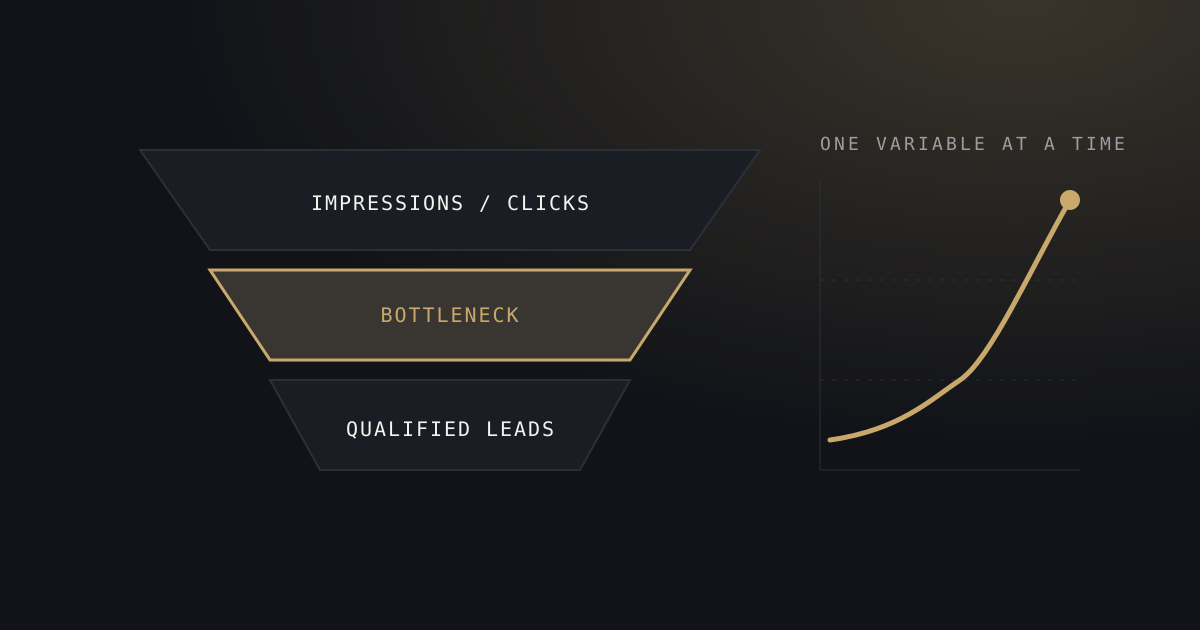
Compare CTR, CPC, landing page conversion rate, cost per lead, qualified lead rate, cost per acquisition, revenue and ROAS where relevant. The cheapest clicks do not indicate the best platform. A low CPC with weak lead quality can cost more per customer than an expensive click that closes. Our article on human targeting vs AI targeting explains why lead quality is the outcome worth chasing.
Evaluate statistical confidence and sample size
If one platform produces four leads and another five, that is not a winner. Small numbers move around by chance, so a result that looks decisive on Tuesday can reverse by Friday. In plain terms: the fewer conversions you have, the less you should trust the gap between two channels. Avoid stopping tests early, and keep the test running long enough to cover your normal conversion delay and sales cycle.
Your 30-Day Social Advertising Platform Test Plan
Thirty days is a suggested planning framework, not a guarantee of sufficient statistical evidence. Test duration should depend on budget, conversion volume, sales cycle and data quality. A longer sales cycle may need considerably more time.
- Days 1 to 3: Set the foundation. Define the customer, objective and success metric. Confirm tracking, including conversion measurement, on every platform.
- Days 4 to 7: Build comparable campaigns. Use the same offer and landing page, adapt creative to each format, and set budgets suited to each platform's anticipated cost per conversion, large enough to gather useful data and within limits you defined in advance. An identical split is not always appropriate.
- Days 8 to 21: Run without interference. Avoid major edits. Check for tracking problems and policy issues only.
- Days 22 to 26: Review quality. Compare lead quality with your sales team, not only the platform dashboards.
- Days 27 to 30: Decide. Scale, hold, extend the test or stop, based on predefined criteria and how much data you collected.
A hypothetical comparison
These figures are illustrative only, not real results.
| Metric (hypothetical) | Platform X | Platform Y |
|---|---|---|
| Spend | $1,500 | $1,500 |
| Clicks | 1,200 | 300 |
| Leads | 30 | 12 |
| Qualified leads | 3 | 8 |
| Cost per qualified lead | $500 | $187.50 |
Platform X produces four times the clicks and more than twice the leads. Platform Y produces fewer clicks and leads, but more than twice as many qualified ones at a much lower cost per qualified lead. On a dashboard, X wins. On the business objective, Y does.
Decide what to do after testing
- Scale the platform with the strongest sustainable business results.
- Keep secondary platforms for different stages of the customer journey, such as remarketing.
- Stop spending on channels that miss defined objectives after a fair test.
- Retest when the audience, creative, offer or market changes.
- Avoid spreading a limited budget across too many channels.
After you choose, keep improving with the process in how to optimize digital advertising campaigns.
Conclusion
The best platform is the one that consistently contributes to your business objectives, not necessarily the one with the lowest CPC or highest engagement. Let tests, quality data and commercial results decide.
Frequently asked questions
What is the best social media platform for business advertising?
There is no single best platform. The right one depends on your audience, offer, buying journey and conversion economics, confirmed through testing.
Are Google Ads a social media platform?
No. Google Search Ads capture existing intent and often complement social channels that create demand. Google Ads also covers YouTube and Display, which serve other roles.
Can I compare Meta Ads and TikTok Ads directly?
Only approximately. Attribution, audience overlap, conversion delays and tracking differ between platforms, so treat comparisons as directional and check CRM outcomes.
Is a 30-day test long enough?
Not always. Thirty days is a planning framework. Budget, conversion volume, sales cycle and data quality determine how long a fair test needs.
Examples in this article are illustrative. Results depend on offer, market, budget, tracking and sales process, and are never guaranteed.
← Back to all articles